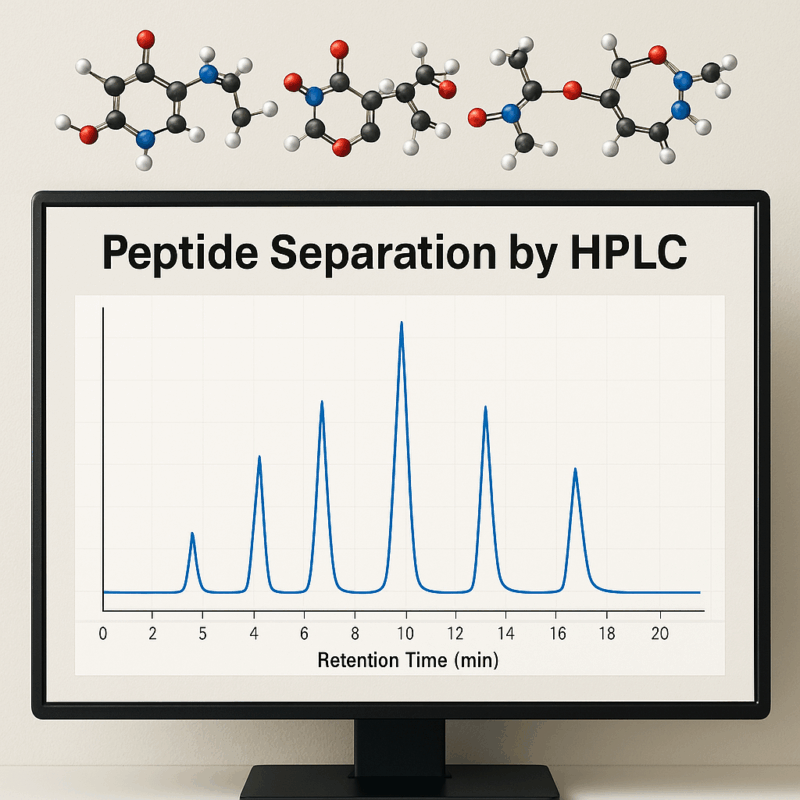
Peptide Pureness & Quantitation Testing
Peptide Purity Guide 98%, 99% & Research-grade Clarified Prg
Straight from the synthesizer with marginal processing-- commonly simply bosom from the material and precipitation. Purity ranges extensively, from 40% to 80%+ depending upon sequence size and trouble. Unrefined peptides appropriate for applications where pureness isn't essential, such as antibody production or initial screening assays where the target peptide simply needs to be existing, not leading. Closely associated with truncations, removal peptides are full-length chains that are missing out on one amino acid someplace in the middle. If covering isn't completely efficient, an uncoupled chain can remain to extend in succeeding actions, producing a peptide that's only one residue except the target.Irregular particle dimension distribution and morphology can impact bioavailability and stability. BOC Sciences is geared up with tools like DLS, TEM, SEM, and so on, to totally examine nanoparticle dimension, distribution, and microstructure. For us, pureness isn't simply a portion-- it's a guarantee of stability, consistency, and regard for the science being done.
Certifications Of Evaluation: How To Read And Translate Lab Records
Other strategies like electrophoresis, capillary electrophoresis (CE), and nuclear magnetic resonance (NMR) can also be utilized to evaluate peptide framework, charge, and purity, guaranteeing detailed characterization. In COA review, it usually includes HPLC pureness screening, mass spectrometry identity confirmation, and batch-specific documentation revealing the tested great deal, technique, results, and date. For peptide pureness testing, reverse-phase HPLC is the conventional conceptual model. The chromatographic purity is after that determined by contrasting the area under the primary optimal with the complete area under all incorporated tops.
Peptide purity describes the amount of the appropriate peptide in the peptide item. Nonetheless, for total top quality analysis or the characterization of peptides for a variety of applications, extra logical examinations are suggested. For example, in order to ensure success in various peptide experiments, it may be necessary to eliminate trifluoroacetic acid (TFA), or to examine the solubility of hydrophobic peptides prior to doing the called for experiments. Throughout the detection, we use RP-HPLC combined with MS to establish the molecular weight of the peptide. The outright amount of the right peptide in a sample is the product of the peptide material and the peptide purity. BOC Sciences has a top-tier peptide high quality screening platform, incorporating innovative analytical technologies and premium instrumentation to supply specific and efficient peptide high quality analysis services.Associated Solutions
The quality and integrity of a peptide purity measurement rely on approach parameters and paperwork top quality. The mobile phase, commonly a mix of water, acetonitrile, and an acid modifier, is saved in storage tanks and delivered with the system by a high-pressure pump. The pump preserves accurate flow rates, commonly in the variety of 0.5 to 2.0 mL/min relying on the method and column style. High pressure requires the mobile phase with tightly loaded fragments inside the column, producing sharper separations and higher resolution than traditional low-pressure chromatography.BOC Sciences, with its Learn here robust analytical platform and expert group, focuses on quality testing services for peptide basic materials, peptide microspheres, peptide nanoparticles, and peptide solution prep work. We deal with biotech, pharmaceutical, CRO, CDMO, and academic teams on peptide chemical and physical evaluations that support research study and non-clinical choice making. Call us today to review your peptide series, sample status, and analytical purposes.
Why Laboratory Recognition Issues In Peptide Quality
- Either can be acceptable, but third-party testing is the gold criterion for research-grade materials.
- Our process is developed to relocate from example context testimonial to interpretable peptide data with very little analytical uncertainty.
- All items are sold for research, research laboratory, or logical functions just, and are not for human use.
- FDA and the European EMA have actually established guidelines mandating detailed analysis and quality assurance for peptide products to make certain safety and effectivenessr.
- Extremely few business research peptide distributors supply MS/MS data on routine COAs-- it is normally scheduled for pharmaceutical-grade materials and progressed research settings.
Notably, this purity number is typically determined after purification (e.g. by HPLC) and concentrates on peptide impurities-- it does not count residual water, salts, or counter-ions in the dried peptide powder. To put it simply, the purity percent has to do with the structure of peptide types in the example, not the weight payment of water or salts. A peptide can be 98% pure (indicating extremely few peptide pollutants) yet still have some water or trifluoroacetate salt; those non-peptide elements would certainly be shown in the net peptide material rather than the pureness portion. At Creative Peptides, we supply personalized peptide chemical and physical analyses for research study groups that require dependable data on peptide identification, purity, structure, remedy habits, and sample high quality. Our solution sustains artificial, modified, cyclic, conjugated, and hard peptide examples with analytical workflows developed around the actual project question rather than a repaired default panel.
A sample could produce a clean-looking chromatogram with one leading peak and still be the incorrect substance if identity was never validated. Multi-Peptide Formula HPLC actions splitting up and loved one peak area; mass spectrometry steps mass-to-charge actions that can be utilized to confirm molecular identity. Peptide purity screening is the process of confirming that a peptide example includes just the intended sequence-- and no considerable impurities or by-products from synthesis. Because peptides are created with intricate chemical procedures, trace pollutants can form naturally. Checking permits scientists to comprehend specifically what remains in the vial, verifying both identity and high quality. Selecting a reliable third-party lab is essential to obtaining reputable peptide validation outcomes.